
IndustriesRail & Transport Infrastructure
Rail & Transport Infrastructure
Rail & Infrastructure — Monitoring movement, condition and change.
Railway infrastructure is long, exposed and shared with moving trains. Small changes in track geometry or surrounding structures can matter, and access to measure them is tightly controlled.
AxioIX’s work in rail centres on a proposed sensor family for monitoring track and infrastructure movement, built on an existing wireless technology foundation.
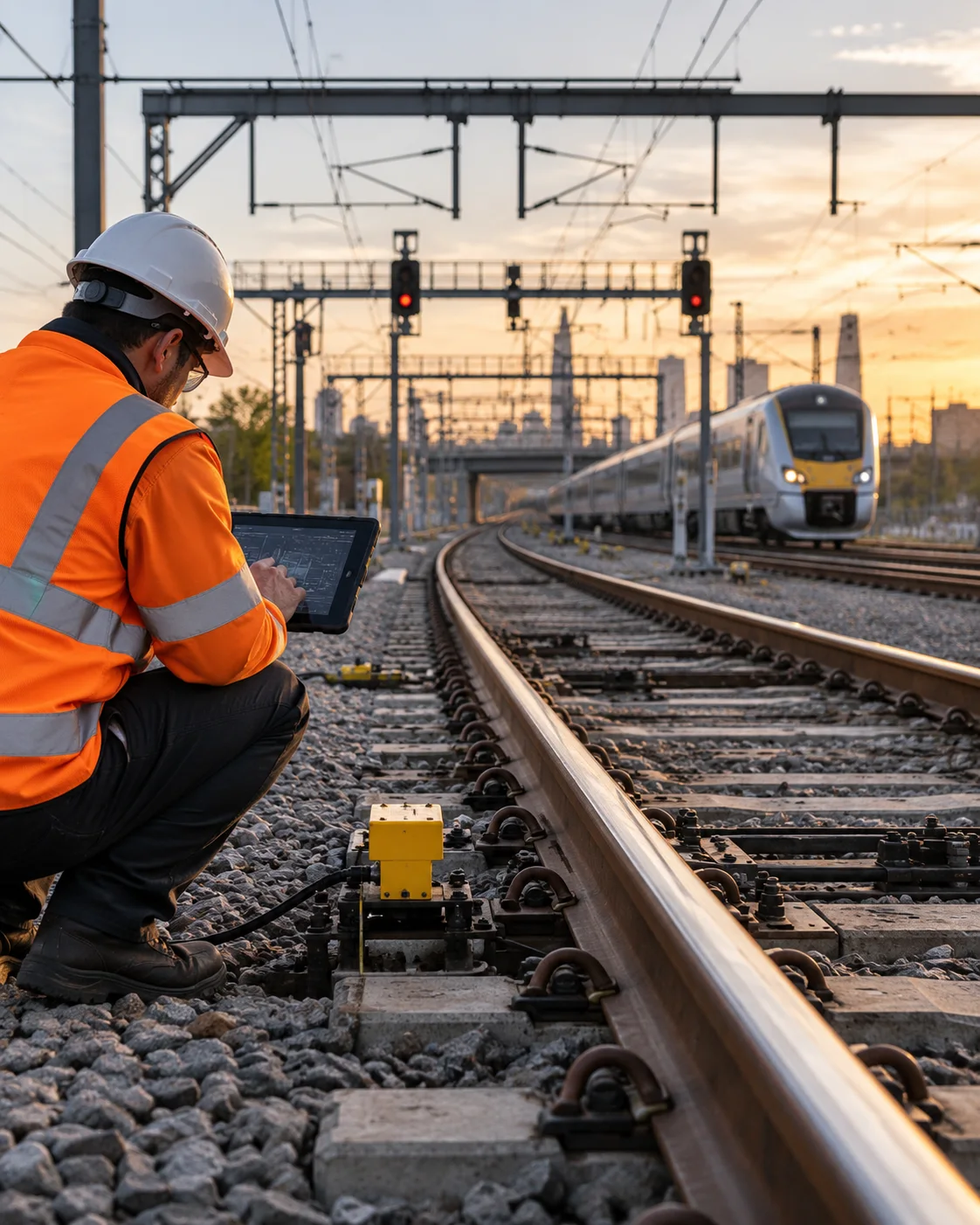
Track geometry
Monitoring the geometry that matters.
Typical monitoring requirements include cant and cross-level, the height difference between the two rails, and twist, the change in cross-level over a length of track. Movement of embankments, structures and other infrastructure can affect both.
Detecting gradual change between inspections can help infrastructure managers decide where closer examination is needed.
Deployment practicality
Practicality matters as much as accuracy.
In rail, a sensor that measures well but takes too long to fit, needs frequent attention or is difficult to commission will not be practical. Track access is limited, so every minute on site counts.
- Mounting
- Secure fixing without compromising the infrastructure.
- Installation time
- Fitting within short access windows.
- Size
- Compact enough to avoid interference with railway operations.
- Commissioning
- Straightforward set-up and confirmation of operation.
- Field maintenance
- Minimal attention over a long service life.
Operating conditions
A demanding environment for electronics.
Railway equipment experiences temperature extremes, vibration and shock from passing trains, and installation in constrained sites, cuttings and tunnels where communications can be difficult.
- Temperature extremes and weather
- Vibration and shock from train movements
- Constrained sites and tunnels
- Intermittent or difficult communications
Distributed monitoring
Power, communications and reliable evidence.
Monitoring points may be spread over long distances. Appropriate power management, communications and reliable evidence collection are central design considerations, along with how information reaches the people who maintain the infrastructure.
- Power management
- Long unattended operation between maintenance visits.
- Communications
- Suited to remote and obstructed locations, including tunnels.
- Evidence collection
- Holding measurements reliably until they can be delivered.
- Information flow
- Reaching the teams responsible for the infrastructure.
Development proposal
A focused first application, a reusable foundation.
The proposed rail sensor family starts with a narrow, well-defined first application. Building on an existing wireless technology foundation lets that first phase concentrate on rail-specific measurement, installation, power and communications questions.
Once proven, the same foundation could support other rail monitoring requirements without starting again.
- First application
- A clearly bounded track monitoring requirement.
- Shared foundation
- Reusable sensing and communications building blocks.
- Further variants
- Other monitoring needs addressed on the same foundation.
Engineering validation
Proof, evaluation, qualification and deployment are different.
Rail requires clear distinctions between a controlled proof of the measurement, evaluation in the field, formal product qualification and approval, and routine operational deployment.
The rail sensor family is a development proposal. It has not completed field validation or operational qualification, and no accuracy or approval claims are made here.
Discuss a rail or infrastructure application.
Talk to AxioIX about track, structure or infrastructure monitoring requirements.