
The AxioIX Platform
Connecting the physical operating environment.
Organisations depend on an increasingly complex physical world of machinery, equipment, infrastructure, facilities, mobile assets and supporting services.
AxioIX’s platform vision is to connect physical evidence with the assets, processes, people and responsibilities that give it operational meaning, so that organisations can understand not only what is happening to an individual asset but how it affects the wider operation.
From isolated monitoring to connected physical-world intelligence.
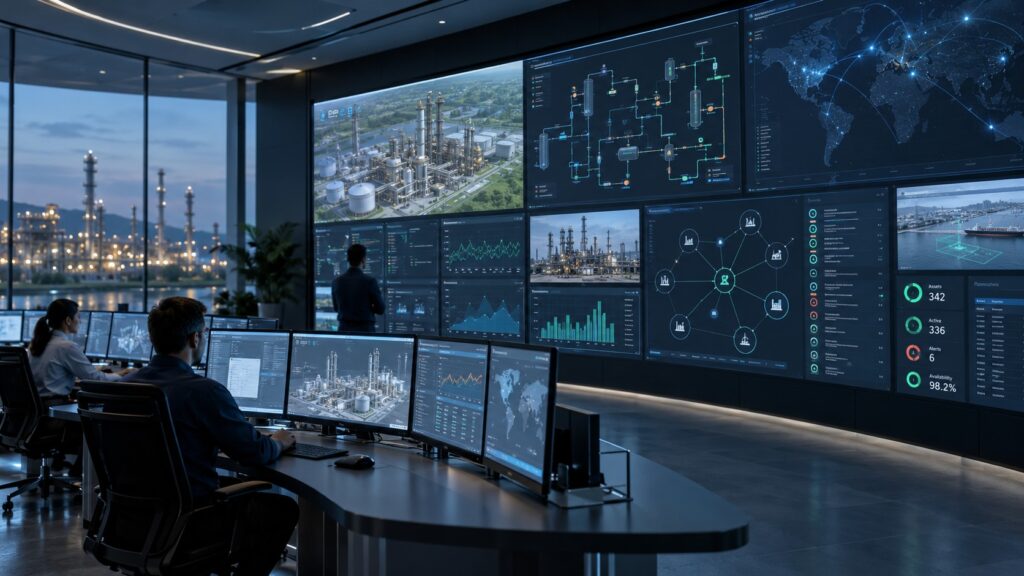
Fragmented monitoring
Many systems. Only part of the picture.
Most organisations have accumulated different technologies to manage specific aspects of their physical operations.
One system monitors rotating equipment. Another tracks mobile assets. A building-management system controls utilities. Production systems record operating states. Maintenance software manages inspections and work orders.
Each system may fulfil its intended purpose, but important relationships between them can remain difficult to observe. A machine condition alert may reveal little about the service the machine supports. An asset location may be visible without its operating state. Maintenance records may not be connected to the physical evidence that justified an intervention.
The problem is not necessarily that these systems are inadequate individually. It is that the organisation often has to reconstruct the wider operating picture across several disconnected applications.
Connecting information across physical assets and operational services creates opportunities that isolated monitoring cannot provide on its own.
A connected view
A connected view of the organisation’s physical world.
The envisioned platform brings together information about the physical things an organisation operates, the conditions they experience and the relationships that determine their operational significance. These are connected aspects of one physical operating environment, not six separate product applications.
- Physical assets and equipment
- Machines, motors, pumps, compressors, conveyors, production equipment, tools, vehicles, infrastructure and other physical assets.
- Identity and location
- Which physical asset is involved, where it is situated, how it is identified and how its location or assignment changes over time.
- Condition and behaviour
- Measurements, operating state, environmental conditions, physical events, abnormal behaviour and relevant historical information.
- Operational relationships
- The processes, circuits, equipment, facilities and services that depend on one another.
- Responsibilities and workflows
- Who operates, maintains or responds to an asset or condition, which work is required and how actions are coordinated.
- Evidence and intelligence
- Recorded measurements, event histories, analytical interpretation, simulations, models, recommendations and verified outcomes.
Illustration
The value is in the relationships.
A condition-monitoring application may detect an abnormal vibration pattern on a pump. That information is useful, but the pump does not operate in isolation.
It belongs to a cooling circuit. The circuit supports equipment and processes in, for example, pharmaceutical manufacturing. Other pumps may provide standby capacity. Maintenance teams have responsibilities for inspection and response.
An integrated physical-world view can connect the pump’s condition to its operating context, the cooling service it supports, available alternatives and the people responsible for responding.
The operational question becomes more meaningful. Instead of asking only whether a pump requires maintenance, the organisation can also examine what the condition may mean for cooling-service reliability, what response is appropriate and which activities may be affected.
This is the additional value AxioIX ultimately seeks to enable.
An illustration of the intended integrated platform capability, not a description of a specific customer deployment.
Connected Digital Twins
Start simple. Connect operations. Build intelligence.
A digital twin does not have to begin with a sophisticated simulation of a physical asset. It can start with a simple digital representation of an asset, process or system, showing its operating state, condition and capabilities.
The real value emerges when these representations are connected.
An equipment fault need not mean a service failure, and several individually healthy assets may still be unable to deliver a required service because of capacity constraints or operational dependencies.
The AxioIX Platform vision is to connect representations of physical assets, processes and services through the relationships that determine how they operate together. This allows organisations to move beyond isolated equipment monitoring towards a connected understanding of operational condition, available capability, dependencies and consequences, adding richer models only where they improve decisions.
Conceptual illustration. Consequences are evaluated through operating relationships, not inherited from the worst component.
Platform architecture
From physical events to connected operational intelligence.
The intended operating model brings six functional layers together, with a feedback path from operating outcomes to updated evidence and interpretation. In current projects, these layers are implemented for the specific application being addressed: measurement, evidence processing, operational context, modelling and simulation are configured around the problem at hand. What is under development is the reusable platform infrastructure that would allow the same layers to be shared across applications, asset populations and sites.
- Physical evidenceMeasurements and events from AxioIX sensing products, suitable third-party instruments, equipment systems, production information and other relevant data sources.
- Sensing and communicationsExisting AxioIX sensor products, suitable third-party instruments, gateways and industrial communication technologies are used in projects today. New connected sensing or communications capability builds on USP, AxioIX’s common and continuously evolving sensing architecture, and rfFlux, its developed communications foundation; these also make larger asset populations more practical. Applications differ in the measurement detail, communication capacity, power efficiency and resilience they need.
- Evidence and data infrastructureRelevant measurements, event records and operating information are preserved, organised and made available for interpretation and integration. Data access, integrity, context, provenance and appropriate retention matter to dependable operational conclusions. Today this is implemented for individual applications; reusable evidence infrastructure shared across applications is under development.
- Context and relationshipsEvidence is connected to the asset, location, operating state, process, service and responsible organisational roles. This is essential to interpreting the operational significance of physical events. Current projects establish the context each application needs; a reusable contextual model spanning assets, processes and sites is part of platform development.
- Intelligence and interpretationEngineering analysis, rules, statistical methods, physical models, simulation and AI where appropriate. Different problems require different analytical approaches; no single technology is mandatory.
- Operational decisions and workflowsRelevant information for operators, maintenance teams, managers and enterprise applications: alerts, dashboards, recommendations, work orders, reports, approved actions and subsequent verification. Today these outputs are delivered for specific applications; broader enterprise workflow integration is part of the platform direction.
Works with what is already there. The architecture uses appropriate existing systems and instruments rather than requiring a complete technology replacement.
Operational perspectives
One operating environment. Different operational perspectives.
The same connected physical-world information can support different users and responsibilities. These are prospective integrated user experiences, not finished AxioIX interfaces.
- Operations and control rooms
- See relevant equipment conditions, events, operational context and potential consequences across connected assets and processes.
- Engineering and maintenance
- Investigate abnormal behaviour, access relevant physical evidence, assess equipment condition and coordinate maintenance responses.
- Facilities and service management
- Understand the condition and availability of supporting infrastructure, utilities, building services and other operational dependencies.
- Management and asset owners
- Gain better visibility into operational performance, reliability, service implications and verified improvement opportunities.
From applications to integration
Building towards integration through practical applications.
AxioIX’s platform ambition does not require an organisation to replace existing technology or commit to a facility-wide deployment from the outset. Value can begin with an individual asset, process or operating problem.
A successful application establishes useful measurements, interpretation and operational information. Where there is a justified requirement, the same foundations may then support additional equipment, connected circuits, wider asset populations and more integrated operating workflows.
For example, a mining application may begin with a mill, screening system or cyclone cluster. Further opportunities may exist in supporting pumps, motors, conveyors and related process equipment. This is where the Balance of Plant strategy contributes to broader physical-world visibility.
Across industries, the progression from individual applications to connected operations should be driven by demonstrated operational value and practical integration requirements.
Foundations and direction
Established engineering foundations. A broader platform ambition.
Today
Industrial solutions creating value
Industrial sensing and physical measurement, analytical engineering, modelling and simulation, and application development, using current AxioIX sensor products, with suitable third-party instruments as part of an established investigation and solution-development approach. Applications incorporate the evidence processing and operational context required for their particular purpose. Mining work demonstrates measurement, analytical interpretation and simulation in practice.
Evolving
Technology foundations
USP and rfFlux are established foundations, extended through each application. The evidence handling, context and integration built for individual applications are being developed into reusable platform services.
Ambition
A connected operating environment
An integrated physical-world operating platform connecting assets, operating conditions, evidence, context and enterprise workflows across the organisation, through additional software, information architecture and operational workflow capabilities, subject to development and partnerships.
Connect more of your physical world.
Whether your organisation needs to understand a specific operating problem, extend monitoring across supporting equipment or explore opportunities for more integrated physical-world intelligence, AxioIX can help establish a practical starting point.